








What Is Texas Hold’em Poker?
Overview of the Game
Texas Hold’em is a poker variant where each player receives two private cards. These are called hole cards, and only you can see them. Five shared cards — called community cards — are dealt face-up on the table. Everyone uses those same five cards to build the strongest possible five-card hand.
You don’t have to use both of your private cards. You don’t have to use all five community cards either. You simply make the best five-card combination available from the seven cards total.
The game is played with a standard 52-card deck. Most tables seat between two and nine players. Each hand includes several rounds of betting, and the goal is straightforward: win the pot.
If you want a broader explanation of how poker works in general, you can look at Wikipedia for a neutral overview of the game structure.
Why Texas Hold’em Is the Most Popular Poker Variant
Hold’em became dominant because it’s easy to follow but hard to master. A beginner can learn the mechanics quickly. An experienced player can spend years refining strategy.
You always have incomplete information. You see your own cards, but not your opponents’. That creates tension. Every bet carries meaning. Every decision can change the outcome of the hand.
Online vs Live Texas Hold’em
The rules stay the same whether you play online or in person. What changes is the pace.
Online games move quickly. Cards are dealt automatically. Bets are calculated instantly. You might play hundreds of hands per hour.
Live poker is slower. There’s more time between decisions. You can observe physical behavior, betting speed, and reactions. But structurally, Texas Hold’em rules are identical in both formats.
Learn the fundamentals of Texas Hold’em and choose your format — online or live. Start playing and put your strategy into action.
Texas Hold’em Rules Explained
Number of Players and Deck
Texas Hold’em uses a regular 52-card deck. No jokers. No special cards.
Most tables have 6 or 9 players. Heads-up games (two players) are also common, especially online.
Hole Cards and Community Cards
At the start of each hand, every player receives two private cards.
After that, five community cards are dealt in three stages:
- The flop: three cards at once
- The turn: one card
- The river: one final card
All players use these same community cards. That’s why the game is called a “community card” variant.
Objective of the Game (Winning the Pot)
The objective is simple: win the pot. The pot contains all the chips wagered during the hand.
You can win in two ways:
- Everyone else folds.
- You show the strongest five-card hand at showdown.
Texas Hold’em Table Layout — Hole Cards and Community Cards
This visual shows where each player’s two private cards are positioned and how the flop, turn, and river are placed in the center of the table during a hand.

Betting Rounds in Texas Hold’em
There are four betting rounds in Texas Hold’em. The flow always follows the same order.
Pre-Flop
After receiving your two hole cards, the first betting round begins. Players decide whether to fold, call the current bet, or raise.
This is where the hand truly starts. Some hands are strong. Many are not. Discipline matters.
Flop
Three community cards are placed face-up. Another round of betting begins.
At this point, players start forming real combinations.
Turn
A fourth community card appears. Betting continues.
The turn often changes hand strength dramatically. A draw might complete. A strong hand might weaken.
River
The fifth and final community card is revealed. This is the last betting round before showdown.
Showdown and Winning the Hand
If more than one player remains after the final betting round, cards are revealed. The best five-card hand wins the pot.
Master every stage of a Texas Hold’em hand and make confident decisions on every street. Start playing today.
Poker Hand Rankings
Understanding hand rankings is essential. Without this, the rest of Texas Hold’em rules won’t make sense.A solid grasp of combinations is also the foundation of effective texas hold’em strategy, since every decision depends on hand strength and position.
High Card to Royal Flush
Before cards are dealt, two players From lowest to highest:
- High Card
- One Pair
- Two Pair
- Three of a Kind
- Straight
- Flush
- Full House
- Four of a Kind
- Straight Flush
- Royal Flush
These rankings determine the winner at showdown.
Examples of Winning Hands
If you hold A♦ A♣ and the board shows A♠ 7♥ 2♣ 9♦ K♠, you have three of a kind.
If you hold J♠ 10♠ and the board shows Q♠ K♠ 2♦ 7♣ 9♠, you have a flush.
The strongest possible hand is a Royal Flush — A, K, Q, J, 10 of the same suit.
How Ties Are Broken (Kickers)
If two players have the same combination, the highest remaining card decides the winner. That card is called the kicker.
For example, two players may both have a pair of Queens. If one has an Ace kicker and the other has a King kicker, the Ace wins.
Blinds, Antes, and Dealer Button
Small Blind and Big Blind Explained
Before cards are dealt, two players post forced bets:
- The Small Blind
- The Big Blind
These bets ensure there is always something in the pot.
Dealer Position and Rotation
BefA dealer button marks the nominal dealer. It moves clockwise after every hand.
Position matters because it determines betting order. Acting later in a round gives you more information before making a decision.
Antes in Tournaments vs Cash Games
Antes are additional forced bets placed by all players. They are common in tournaments and increase the size of the pot before any cards are played.
Texas Hold’em Game Types Online
The structure of Texas Hold’em rules remains consistent, but formats vary.
Cash Games
Players buy in with real money. Blinds stay the same. You can leave whenever you choose.
Sit & Go Tournaments
These tournaments begin once enough players register. Blinds increase at scheduled intervals.
Multi-Table Tournaments (MTTs)
Large tournaments with many players across multiple tables. The last remaining player wins.
No-Limit vs Limit vs Pot-Limit
- No-Limit: You can bet any amount of your stack.
- Limit: Betting amounts are fixed.
- Pot-Limit: Maximum bet equals the current pot size.
No-Limit Hold’em is by far the most common format.
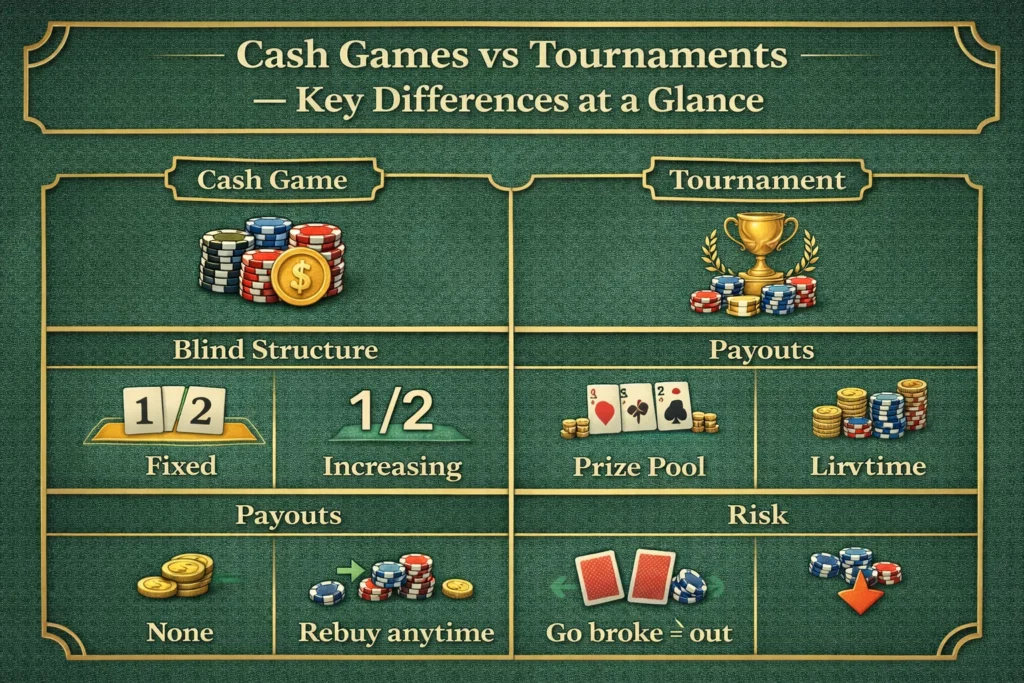
Cash Games vs Tournaments — Key Differences at a Glance
This comparison highlights how blind structures, payout systems, and risk levels differ between formats. Understanding these differences helps beginners choose the right environment to start learning Texas Hold’em.
Ready to Try Texas Hold’em?
Learning Texas Hold’em rules does not take long. Becoming comfortable with them takes a bit of practice. Start slowly. Play low stakes or free games. Focus on understanding hand strength and betting order before worrying about advanced strategy.
Once the structure feels natural, the game becomes far more enjoyable.
FAQ
What are the basic rules of Texas Hold’em?
Each player gets two private cards. Five community cards are dealt. The best five-card hand wins, unless all other players fold.
How many cards do you get in Texas Hold’em?
Two private cards. Five community cards appear during the hand.
What is the best starting hand in Texas Hold’em?
Pocket Aces is statistically the strongest starting hand.
How do betting rounds work in Texas Hold’em?
There are four betting rounds: pre-flop, flop, turn, and river.
What is the difference between No-Limit and Limit Hold’em?
In No-Limit, you may bet your entire stack. In Limit, betting amounts are restricted.
Is Texas Hold’em easy to learn for beginners?
Yes. The rules are simple. Understanding strategy takes more time.